
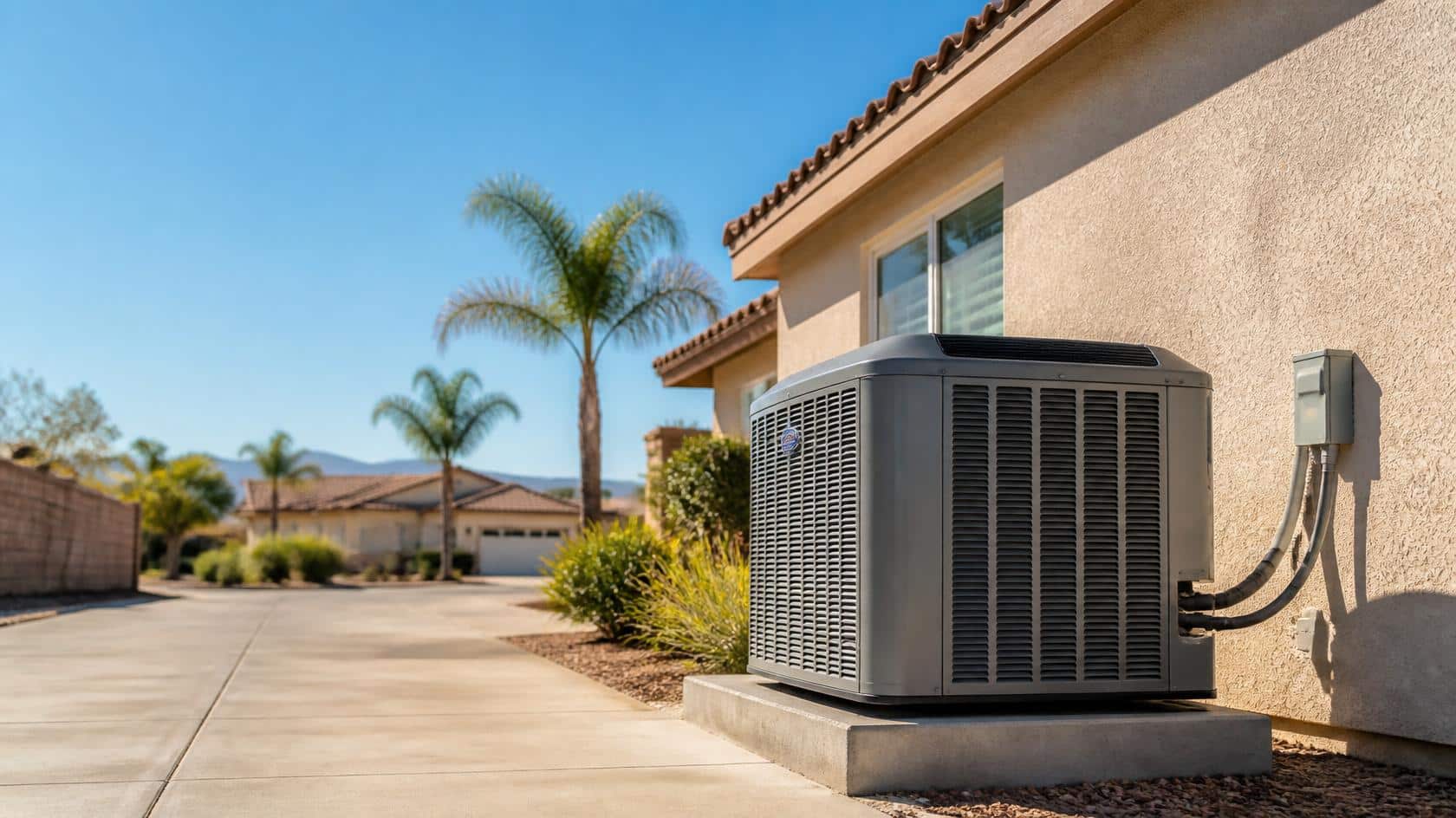
AC Repair vs. Replacement: How to Know Which You Actually Need
Your AC quits at 4 p.m. on a 104-degree Ontario afternoon. The tech gives you a number. And now you're standing in the driveway doing math you never wanted to do: patch it, or replace the whole thing?
We've been answering that exact question for Inland Empire families since 1973. Here's the framework we actually use on a service call. Not a sales script, the real thing.
Age tells you most of what you need to know
Central AC in our valley lasts about 10 to 15 years. Not 20. Our units run harder than almost anywhere in the country. Five, six months a year of full-tilt cooling wears a compressor down faster than the same unit would wear in a milder climate.
So age is where we start:
- Under 8 years: Repair it. The system has years left and the parts are cheap. Replacing now means throwing away a decade of life you already paid for.
- 8 to 12 years: It depends. This is the range where the repair cost and the unit's history actually decide it, so keep reading.
- 12+ years: Lean toward replacement, even when a fix is possible. You're not buying a repair at this point; you're buying a little more time on a system that's already on its way out.
Can't find the age? Check the metal label on the outdoor condenser. The manufacture date is stamped right on it.
The "cost times age" rule settles most arguments
Here's the shortcut. Take the repair quote and multiply it by the unit's age in years. Land over about $5,000, and replacement usually wins.
A $400 fix on a 6-year-old unit is $2,400. Fix it, no hesitation. A $700 fix on an 11-year-old unit is $7,700, and now you're feeding money into something that'll be back on the repair list next summer. Same $700, completely different decision. That's the whole point of the rule: it forces the unit's age into a choice people usually make on the repair price alone.
The R-22 trap catches people every summer
This is the one that blindsides homeowners, so read this part twice.
If your system is roughly 12 years or older, it may run on R-22 refrigerant, what most people call Freon. The U.S. stopped producing and importing R-22 in 2020. It didn't get banned from your unit; it got scarce. And scarce means expensive.
So when an older system springs a refrigerant leak, the recharge alone can run into four figures before anyone fixes the actual leak. We've handed people a refrigerant quote on a 14-year-old unit and watched the replacement math click into place on the spot. If a tech mentions your old system needs refrigerant, that's usually the moment repair stops making sense.
Your electric bill has been telling you for a while
A dying AC rarely dies quietly. It gets expensive first.
If your July bill keeps creeping up while your thermostat habits haven't changed, the system is working harder to move the same amount of cool air. A unit from 2011 simply can't match what a modern high-efficiency system does with the same electricity. And in a climate where the AC runs half the year, that gap shows up on every statement. For a lot of homes here, the monthly drop in cooling costs covers a real chunk of a new system over time, and financing can spread the rest into payments that land close to what you were already losing to the old unit. Not all of it. A real chunk.
Two repairs in one season is the system talking
One repair is just a repair. A pattern is a verdict.
If you've called for service twice in two years, or you're staring down your second real fix this summer, the unit is telling you something. Keep repairing at that point and you're not saving money. You're financing the breakdown in installments.
"It runs" and "it works" aren't the same thing
Sometimes the unit turns on and the house still isn't right. Watch for the back bedroom that never cools while the living room freezes, air that stays sticky even with the AC running, weak airflow at the vents, or a system that runs all afternoon and never catches up.
A repair rarely fixes these. They usually point to a system that's undersized, worn out, or no longer a match for the house, and that's a replacement conversation, not a parts conversation.
When we'll tell you to just repair it
We say this on plenty of calls, because it's often true: fix it.
Repair is the right move when the unit is under 8 to 10 years old, it's been dependable, and this is a one-off: a capacitor, a contactor, a fan motor, a clogged drain line. If that's your situation, spending thousands on a replacement would be a waste, and we'll say so to your face. Recommending a repair we could've upsold is how you're still in business after 50 years.
Get a straight answer before you spend a dollar
There's real money on both sides of this decision, which is exactly why you want someone who'll show you the unit, not just hand you a quote. We're family-owned, licensed, and fully insured, and every job is backed by our 100% satisfaction guarantee. Repair or replace, you'll see why, and you'll never get pushed toward the bigger ticket.
Not sure which way to go? Call Klaus & Sons at 909-655-4636. We'll come out, show you what's actually happening with your system, and give you a free estimate, repair or replacement. Serving Montclair, Chino Hills, Ontario, Upland, Rancho Cucamonga, and the greater Inland Empire.
Expect 10 to 15 years, on the shorter end of the national range. Summers in Ontario, Upland, and Rancho Cucamonga push units through long stretches of triple-digit heat, so a system here logs far more run-time than the same model would in a cooler climate. That extra wear is exactly why age matters so much in the repair-or-replace call.
Not on its own. A system that cools fine in June but falls behind in a late-August heat wave might just need service, a refrigerant check, or better airflow. But if it's over 10 years old and struggling every summer, it may be undersized or worn out for the load our valley puts on it. We'll test it under real conditions before recommending anything.
Yes. AC changeouts in San Bernardino County cities generally require a permit, and cutting that corner can cause problems when you sell the home. As a licensed contractor (CSLB #320990), we pull the permits and handle inspection so the install is done to code and on record.Are older R-22 systems still worth repairing in Upland?
It depends on the repair. A minor fix on an otherwise healthy R-22 unit can be fine. But any repair involving refrigerant gets expensive fast, since R-22 hasn't been produced or imported in the U.S. since 2020. On a 12-plus-year-old Upland system with a refrigerant leak, replacement usually wins on cost alone.
Absolutely. An aging system loses efficiency and has to run longer to hit the same temperature, and here that means running for a big chunk of the year. If your Montclair or Chino Hills summer bills keep climbing while your habits haven't changed, the unit is quietly costing you money before it ever breaks down.